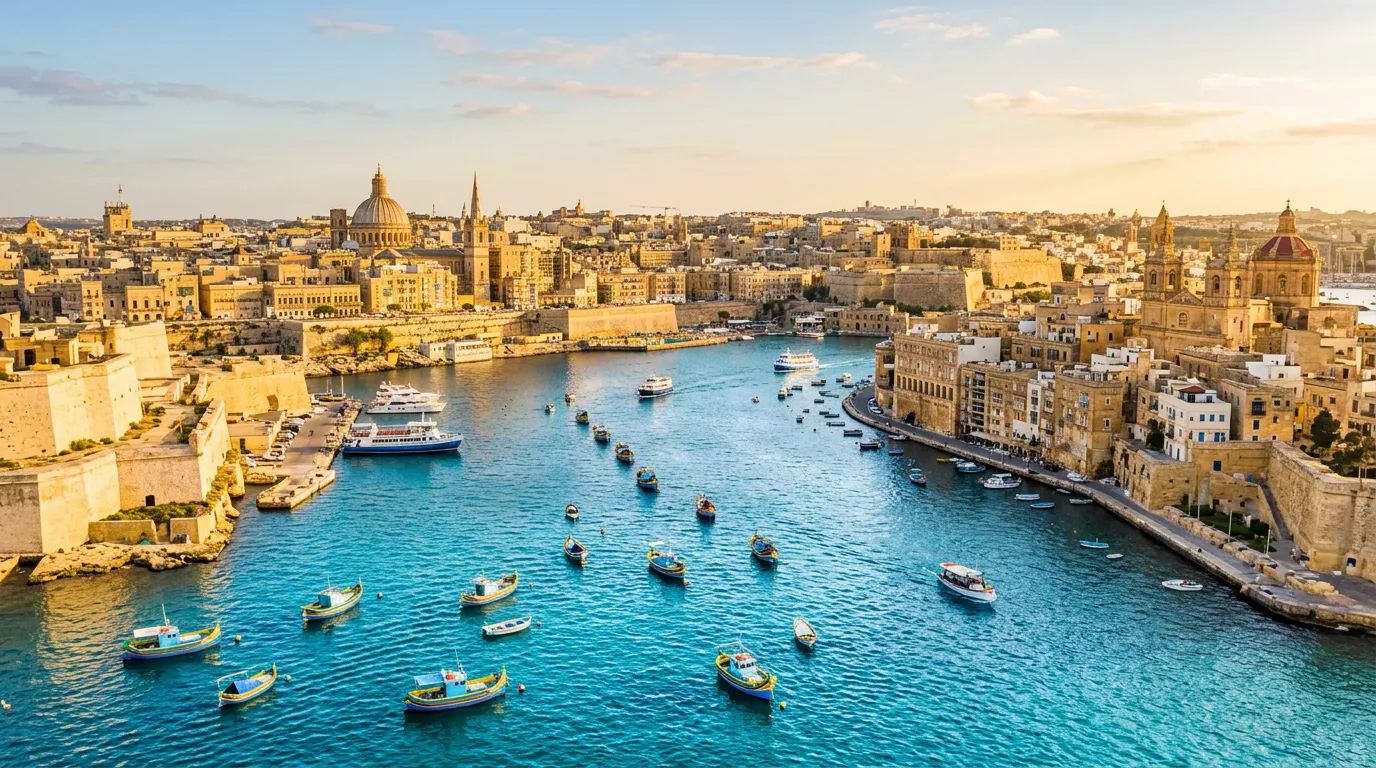
Malta is one of Europe’s smallest countries and also one of its most underrated destinations for expatriates. Sitting at the crossroads of Europe and North Africa in the heart of the Mediterranean, this archipelago of three inhabited islands, Malta, Gozo and Comino, has quietly become one of the most attractive relocation destinations for Europeans, remote workers, entrepreneurs and retirees looking for a combination of sun, English-speaking culture, EU membership and a genuinely manageable cost of living compared to Western European capitals.
The numbers speak for themselves. Malta consistently ranks among the top European destinations for quality of life indices, and its expatriate community has grown significantly over the past decade, driven by its favourable tax environment, its status as a full EU member state, and a lifestyle that combines Mediterranean warmth with a surprisingly efficient administrative system. For anyone considering a move to Malta, understanding the practicalities of settling, working, and building a life on the island is the essential starting point, and working with this company can make the process of setting up professionally on the island considerably smoother for those who plan to run a business or work independently.
Why Malta attracts so many expatriates
Malta’s appeal for expatriates is built on a specific combination of factors that few other European destinations can replicate simultaneously.
English is an official language alongside Maltese, which eliminates the language barrier that makes settling in France, Germany or Spain significantly more demanding for English-speaking expatriates. Government services, banks, healthcare, schools and daily commercial life all operate fluently in English. This is not a tourist accommodation but a constitutional reality: Malta was a British colony until 1964, and English is genuinely embedded in the institutional fabric of the country.
EU membership, which Malta obtained in 2004, means that citizens of all EU member states can live and work in Malta without visas, residence permits or work authorisations beyond simple registration. For non-EU nationals, Malta offers several structured pathways including the Malta Permanent Residence Programme and the Global Residence Programme, which provide long-term residency in exchange for property acquisition or rental and a minimum tax contribution.
The climate is the most immediately obvious advantage. Malta enjoys over 300 days of sunshine per year, mild winters that rarely see temperatures drop below 10°C, and warm Mediterranean summers. For expatriates coming from Northern Europe, Ireland or the UK, this climatic shift alone transforms daily quality of life in ways that are difficult to overstate.
The tax environment is one of the most competitive in the EU. Corporate tax in Malta is nominally 35%, but a system of tax refunds available to non-resident shareholders reduces the effective rate to as low as 5% in certain structures. Personal income tax for non-domiciled residents follows a remittance basis, meaning foreign-source income that is not remitted to Malta is not subject to Maltese tax.
The practical realities of settling in Malta
Understanding the appeal is one thing. Navigating the practical steps of settling in Malta is another, and the reality is more manageable than many expatriates expect once the key administrative steps are understood.
EU citizens moving to Malta must register with the Identity Malta Agency within three months of arrival to obtain an eResidence card, which serves as proof of the right to reside and work. This registration requires proof of accommodation, proof of sufficient financial resources or employment, and a valid national ID card or passport. The process is straightforward and can typically be completed in a single visit to the relevant office.
Finding accommodation in Malta requires realistic expectations about the market. Rental prices have increased significantly over the past decade driven by growing demand from expatriates, remote workers and students. The most popular areas for expatriates are Sliema, St Julian’s and Gzira on the main island, which offer proximity to the main commercial areas, restaurants and the waterfront. Valletta, the capital, is increasingly popular for its architectural character and central location. Gozo offers a more rural and quieter lifestyle at generally lower prices.
Opening a bank account in Malta as a non-resident or new resident requires proof of address, proof of identity and in some cases proof of income or employment. The main Maltese banks are Bank of Valletta and HSBC Malta, both of which have English-language services as standard. Several international digital banks also operate in Malta under EU licences and are used by many expatriates for daily banking.
Healthcare in Malta operates through a dual public and private system. EU citizens are entitled to access the public healthcare system, known as Mater Dei Hospital and its network of health centres, at no cost by presenting their European Health Insurance Card. For more immediate or specialist access, private healthcare is widely available and considerably cheaper than in the UK or Ireland for equivalent services.
Working in Malta : employment, freelancing and business formation
Malta’s labour market is diverse and internationally oriented. Key employment sectors include financial services, iGaming and online gambling, technology, tourism and hospitality, and maritime services. English proficiency is the primary requirement for most professional roles, and salaries in the financial services and technology sectors are competitive by EU standards.
Freelancers and self-employed workers can register as self-employed with the Malta Tax and Customs Administration and obtain a VAT number if their annual turnover exceeds the registration threshold. The registration process is relatively straightforward and can be completed online.
For entrepreneurs and business owners, Malta’s company formation framework is one of the most structured in the EU, with clear processes for incorporating a limited liability company, registering for tax and VAT, and accessing the tax refund system available to non-resident shareholders. The specifics of corporate structure and tax optimisation in Malta are complex enough that professional guidance is consistently recommended for anyone planning to operate a business on the island.
The lifestyle of an expatriate in Malta
Daily life in Malta as an expatriate is characterised by a combination of European efficiency and Mediterranean rhythm that takes most new arrivals a few months to fully appreciate. The island is small enough, 316 square kilometres for the main island, that most destinations are reachable in under 40 minutes by car, though traffic in the main urban areas can be significant during rush hours.
The food scene is excellent and underrated. Maltese cuisine combines Italian, North African and Middle Eastern influences in a way that reflects the island’s complex history, and the restaurant scene in Valletta, Sliema and St Julian’s covers everything from high-end Mediterranean dining to casual street food. Seafood is outstanding and priced well below what equivalent quality would cost in London or Dublin.
The social life for expatriates in Malta is active and well-organised. The expatriate community is large enough to have its own networks, events and online groups, and integration with the local Maltese community is generally smooth given the shared English language and the cultural openness that characterises a country accustomed to international presence.